

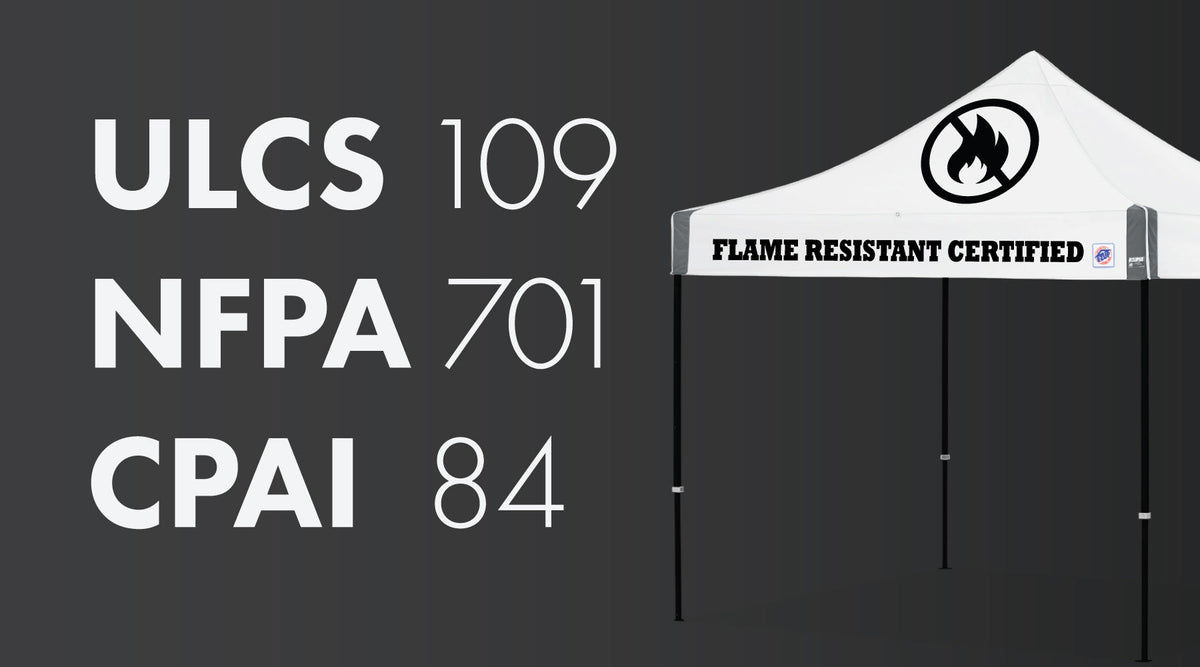
If you sell at markets, exhibit at trade shows, serve food outdoors or operate a branded event booth, an organizer may ask for proof that your canopy fabric meets a recognized flame-resistance standard. The three names most often seen on canopy documentation are CAN/ULC-S109, NFPA 701 and CPAI-84.
They are not interchangeable labels, and none of them means that a canopy is fireproof. This guide explains what each standard addresses, what documentation an organizer may request and how to prepare before an event in Canada.
Quick comparison of canopy fire standards
| Standard | What it addresses | Where you may encounter it |
|---|---|---|
| CAN/ULC-S109 | Flame tests for flame-resistant fabrics and films | Canadian venues, municipalities and event requirements |
| NFPA 701 | Flame-propagation testing of textiles and films | Events, exhibits and public venues in Canada and the United States |
| CPAI-84 | Flammability requirements for camping-tent materials | Recreational tents and some portable-shelter product specifications |
The authority having jurisdiction—such as the venue, municipality or fire department—decides which documentation it accepts. Always confirm the exact requirement for your location, event and use.
What is CAN/ULC-S109?
CAN/ULC-S109 is the Canadian standard titled Flame Tests of Flame-Resistant Fabrics and Films. It evaluates the flame behaviour of fabric or film specimens using prescribed test methods. It does not certify a canopy frame for wind resistance, structural strength or general product quality.
Canadian event documents may refer to CAN/ULC-S109, ULC-S109 or an edition-specific version of the standard. Ask the organizer which certificate, fabric label or test documentation must be submitted and whether it must match the canopy top, sidewalls and other fabric components separately.
What is NFPA 701?
NFPA 701 is published by the National Fire Protection Association. It provides standard methods for testing how textiles and films propagate flame under specified conditions. Canopy tops, sidewalls, banners and decorative fabrics may be evaluated under applicable methods.
A fabric that meets NFPA 701 is flame resistant under the test conditions; it is not fireproof. The rating does not replace rules concerning open flames, cooking equipment, heaters, generators, electrical installations, clearances or emergency exits.
What is CPAI-84?
CPAI-84 is a specification focused on the flammability of materials used in camping tents. You may see it in recreational-tent and portable-canopy specifications, but an event organizer may require a different standard or additional documentation. Do not assume a CPAI-84 statement will automatically satisfy a request for NFPA 701 or CAN/ULC-S109.
Which fire certificate does an event vendor need?
There is no single answer for every Canadian event. Requirements can depend on the municipality, venue, tent or canopy size, whether sidewalls are installed, occupancy, cooking or heating use and the authority reviewing the setup.
Before buying or arriving at an event, ask:
- Which flame-resistance standard and edition are accepted?
- Is a sewn-in label enough, or must a separate certificate be submitted?
- Must the certificate identify the exact product, fabric, model or production lot?
- Do the requirements apply to the top, sidewalls, banners, table covers and other fabrics?
- Are cooking, heating, generators or electrical equipment subject to additional permits and clearances?
- When is the documentation due?
For a practical preparation checklist, read our Canadian event-vendor fire-certification guide.
How to find an E-Z UP canopy fire certificate
Certification can vary by shelter model, fabric grade and component. Match the label and documentation to the exact canopy top, sidewall or accessory you plan to use. Do not use one product's certificate as proof for a different fabric component.
Download available E-Z UP canopy fire certificates for professional, commercial and recreational fabrics. If you are unsure which document applies, contact E-Z UP Australia with the product name, model or SKU and the standard requested by the organizer.
Choosing a canopy for markets, festivals and commercial events
Fire documentation is only one part of selecting an event canopy. Also consider frequency of use, frame construction, fabric grade, size, compatible sidewalls and the anchoring required for the site. Compare our heavy-duty canopy tents for frequent professional use or explore custom-printed canopies for branded events.
Planning a multi-unit, corporate or custom setup? Request a commercial canopy quote and tell our team which event documentation you need.
Frequently asked questions
Does fire resistant mean fireproof?
No. Flame-resistant fabric is designed and tested to limit ignition or flame propagation under specified test conditions. It can still burn or be damaged by heat and flame.
Are CAN/ULC-S109, NFPA 701 and CPAI-84 the same?
No. They are distinct standards with different scopes and test methods. The event organizer or authority having jurisdiction must confirm which one it accepts.
Does a canopy fire certificate cover the frame?
These documents generally concern the tested fabric or film. They should not be interpreted as structural, wind or weather certification for the frame.
Do sidewalls need separate documentation?
They may. Ask whether every fabric component must carry a label or have supporting documentation, especially when a canopy is enclosed or used for food service.
This article provides general product-selection information, not legal, engineering or code-compliance advice. Requirements vary by jurisdiction, venue and use and can change over time.